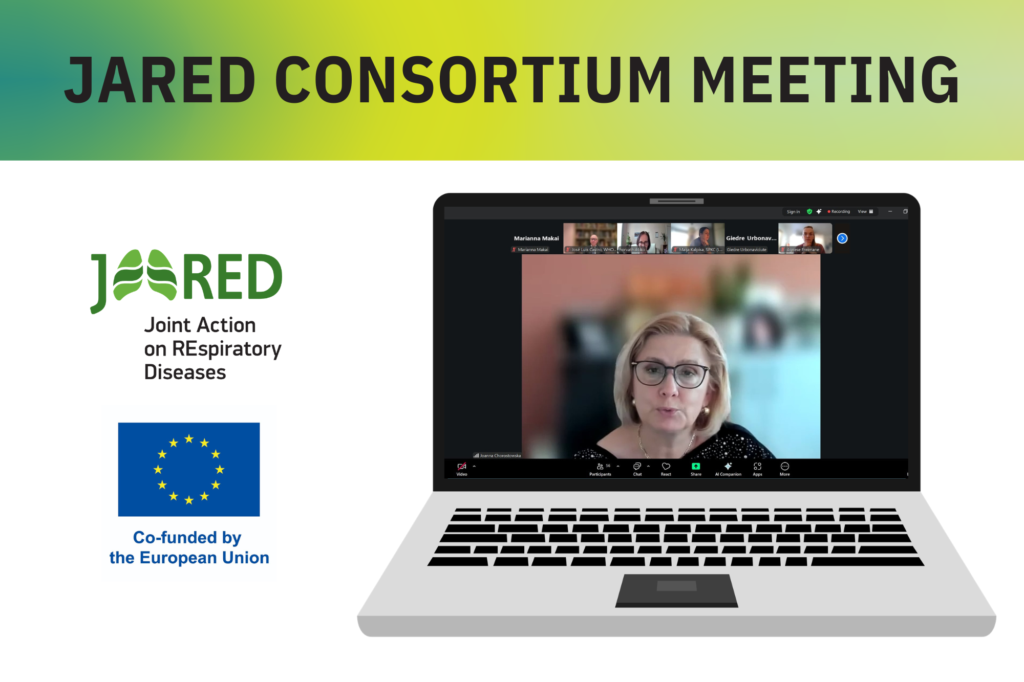
On 25 February 2026, the JARED Joint Action consortium met online to mark the completion of its first year of coordinated European action against chronic respiratory diseases. The meeting, chaired by Prof. Ildikó Horváth, JARED Scientific Coordinator, provided an important opportunity to reflect on achievements, strengthen strategic partnerships, and reaffirm the shared commitment to improving lung health across Europe.
Opening the session, Prof. Horváth highlighted the significance of reaching the first major milestone of the project. The first year was not only about delivering on commitments, but also about building a truly collaborative European structure. Working across countries, institutions and disciplines, partners have successfully met their planned deliverables and milestones, while contributing substantially to advancing knowledge and coordinated action in the field of chronic respiratory diseases. She expressed her gratitude to the work package leaders and consortium members, emphasizing that leading tasks across multiple European countries requires both professional dedication and strong mutual trust — and that this model is proving to be highly effective.
The meeting featured high-level opening remarks that underscored the growing international recognition of lung health as a public health priority. Representing the World Health Organization, José Luis Castro, WHO Director-General’s Special Envoy for Chronic Respiratory Diseases, addressed the consortium and placed JARED’s work into a broader global perspective. He reminded participants that chronic respiratory diseases remain the sixth leading cause of death in Europe, accounting for nearly 400,000 deaths annually and affecting more than 82 million people. Chronic obstructive pulmonary disease (COPD) alone is responsible for the majority of these deaths.
In his speech, he stressed that while the world recently celebrated physical performance and resilience during major global events, millions of Europeans continue to struggle with preventable and underdiagnosed lung conditions. He highlighted the urgent need for early diagnosis, targeted screening of high-risk populations, protection of youth from emerging nicotine products, and stronger integration of lung health into primary care systems. His message was clear: if action is taken only when patients reach advanced stages of disease, intervention comes too late. Coordinated prevention and early detection must become central pillars of health policy.
The consortium was also honored by the address of Joanna Chorostowska-Wynimko, President of the European Respiratory Society (ERS). She emphasized how closely JARED’s objectives align with the ERS pillars of science, research, education and advocacy. She particularly welcomed JARED’s comprehensive scope, which goes beyond COPD to include interstitial lung diseases, occupational respiratory conditions, and prevention efforts linked to early lung development. By addressing chronic respiratory diseases in a broad and integrated manner, JARED contributes not only to scientific advancement but also to raising awareness among policymakers and the wider public. Strengthening advocacy at the European level is essential to ensure sustained investment in prevention, research and equitable access to care.
Following the opening session, the consortium reviewed its one-year achievements and explored strategic synergies with other European initiatives. Work Package leaders presented progress on prevention with a focus on early lung development (WP5), early detection, diagnosis and treatment pathways (WP6), and a life-span approach to living with chronic respiratory diseases (WP7). Particular attention was given to reaching high-risk and vulnerable populations (WP8), recognizing that social and occupational inequalities continue to shape lung health outcomes across Europe.
The meeting also highlighted collaboration with related European Joint Actions and initiatives, including SOLACE, JA NCD Prevent, JACARDI, LH4L (Lungs Europe) and JA-SAFE. These synergies strengthen the overall impact of European health promotion strategies, support smoke-free environments, and contribute to school-based and community-level prevention efforts. By aligning scientific evidence, public health policy and implementation activities, JARED demonstrates how coordinated action can move from fragmented initiatives toward shared European progress.
The first year of JARED shows that large-scale collaboration across Member States is not only possible but productive. Beyond delivering technical outputs, the consortium has established a strong foundation for long-term impact: building common frameworks, fostering knowledge exchange, and reinforcing the place of chronic respiratory diseases within the European health agenda.
As the project moves into its next phase, the focus remains clear: prevention, early diagnosis, equitable access to care and sustained advocacy for lung health. The first anniversary was not only a celebration of achievements, but a reaffirmation that coordinated European action is essential — because lung health cannot wait.