
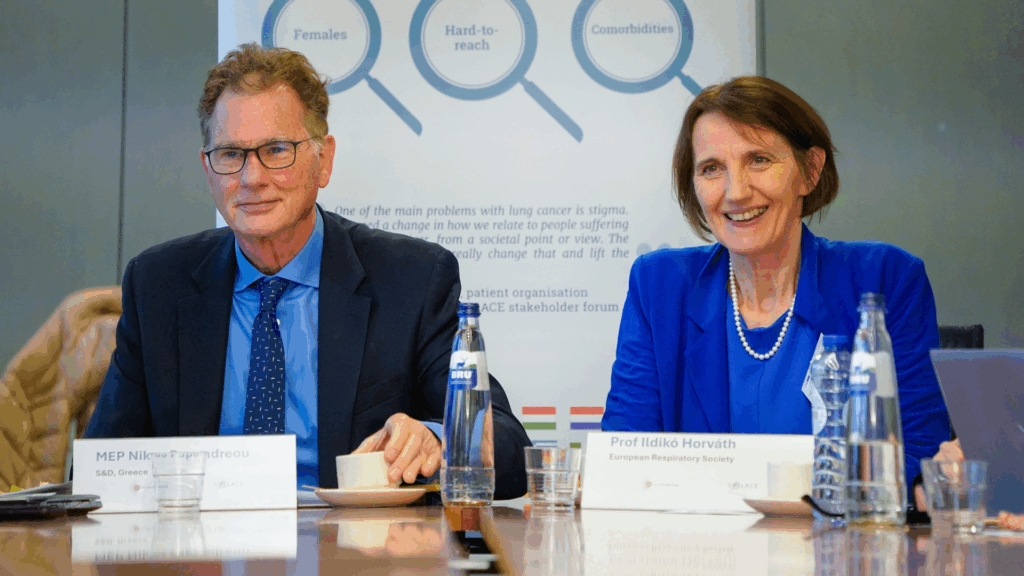
European Parliament and Commission insights on the future of lung cancer screening in Europe
At a recent SOLACE event at the European Parliament, we spoke with MEP Nikos Papandreou (S&D, Greece) and Dr Ciaran Nicholl from the European Commission’s Joint Research Centre about how research and impact from projects like SOLACE can help shape EU policy.
Why lung cancer screening matters
Across Europe, lung cancer is still not always included in national screening programmes, even though it remains the biggest cancer killer. Finding lung cancer early can save lives, but too often, people are diagnosed when the disease is already advanced and harder to treat.
National lung cancer screening programmes for people at high risk could change this, improving survival and reducing the healthcare service costs linked to treating more advanced disease.
MEP Nikos Papandreou, who hosted the event, highlighted the urgency of this issue:
How SOLACE supports EU lung cancer screening guidelines
Dr Ciaran Nicholl also joined the event and shared an update on EU lung cancer screening guidelines. Following a call for experts last summer, a working group of specialists and patient advocates will begin developing evidence-based guidelines by the summer of 2026.
These guidelines will be designed for European health systems, with projects such as SOLACE helping to shape them. SOLACE pilot studies are testing screening approaches with high-risk groups across Europe, building real-world evidence on what works and what challenges exist in different EU Member States.
Watch Dr Ciaran Nicholl explain:
The next key milestone is the European Commission’s Initiative on Lung Cancer (EC-LuC), which is expected to provide clear direction for rolling out screening across Europe. Meanwhile, MEPs are encouraged to keep urging the Commission to continue funding programmes that support lung cancer screening to reduce the impact of Europe’s biggest cancer killer.
Access lung cancer screening resources for the public and professionals