SOLACE+ consortium gathers in Vienna to launch ambitious lung cancer screening project
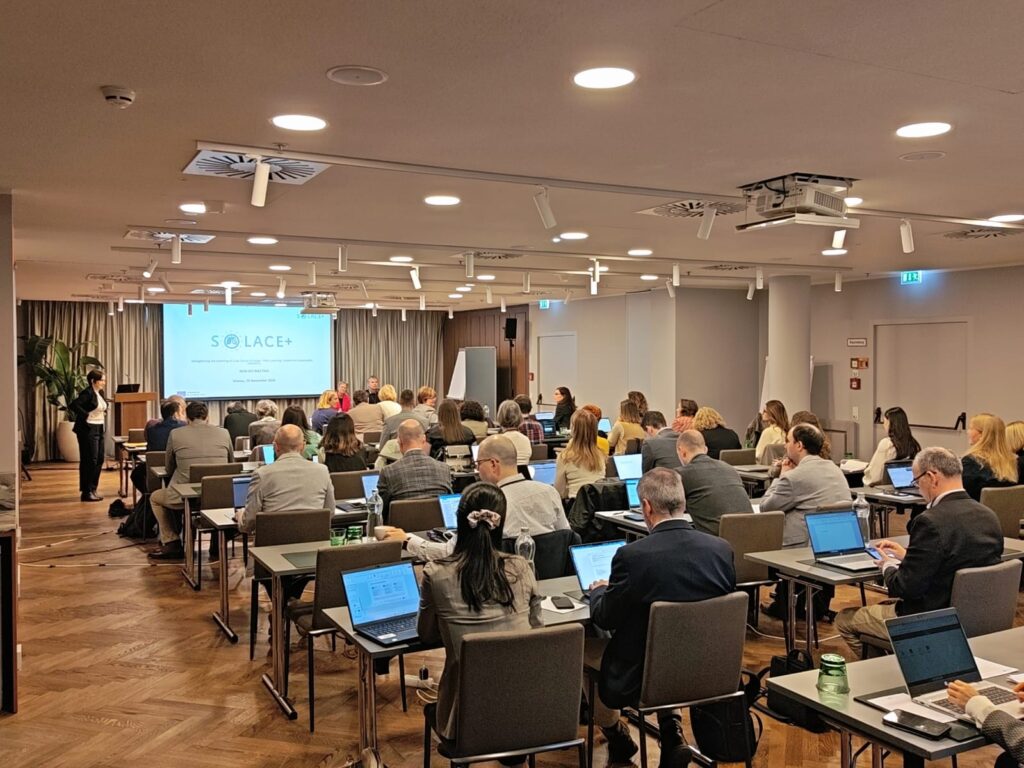
Vienna, 25 November 2026 – The SOLACE+ consortium officially kicked off today as 46 partners from 22 EU Member States and Norway gathered in Vienna, to begin their collaborative work scaling up lung cancer screening across Europe.
Building on the remarkable success of the original SOLACE project, which screened more than 30,000 people across 12 countries, SOLACE+ will strengthen screening implementation, learning, uptake and sustainability in 19 countries over the coming years.
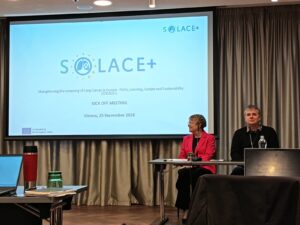
Scientific Coordinators Professor Rozemarijn Vliegenthart and Professor Torsten Blum opened the meeting with an overview of SOLACE+ objectives, structure, and key timelines. The project aims to establish robust evidence, implementation frameworks, and quality standards that will enable European countries to launch and sustain effective lung cancer screening programmes.
Dr Debora Fumagalli (HaDEA, SOLACE Project Officer) and Dr Daniele Fiorenza (EC DG SANTE Policy Officer) joined the consortium to share the European Commission’s perspective and expectations for the project, underscoring the importance of this work within the EU’s Beating Cancer Plan.
The kick-off meeting featured detailed presentations from all nine work package leads, outlining how the consortium will tackle different aspects of lung cancer screening implementation:
- WP1 (Project Management and Coordination): Establishing governance bodies and coordinating activities across the consortium, led by E. Alamaro and M. Hierath.
- WP2 (Evidence, Implementation, Quality Framework): Developing the framework for European lung cancer screening pilots and programmes, presented by T. Blum and R. Vliegenthart.
- WP3 (Inclusive Screening): Optimising enrolment and adherence beyond baseline LDCT to ensure screening reaches all eligible populations, led by A. Kerpel and T. Laisaar.
- WP4 (Standards and Quality Assurance): Setting standards for technical performance, radiation protection and nodule management in low-dose CT screening, presented by A. Snoeckx and L. Seijo.
- WP5 (Smoking Cessation Integration): Integrating structured smoking cessation measures into screening programmes and managing positive screening results, led by M. Vasakova and R. Ledda.
- WP6 (Tobacco-associated Comorbidities): Addressing comorbidities and incidental findings related to tobacco use, presented by J. Chorostowska and H.-U. Kauczor.
- WP7 (AI Integration): Exploring how artificial intelligence can support and enhance lung cancer screening, led by M.-P. Revel and C. Jacobs.
- WP8 (Evaluation, Training, Sustainability): Evaluating project outcomes, developing training materials, and cooperating with the European Lung Cancer Screening Alliance (ELCSA), presented by H. Prosch and G. Hardavella.
- WP9 (Community and Stakeholder Engagement): Building community engagement, stakeholder strategies, and dissemination activities, led by C. Comolli and C. Genton.
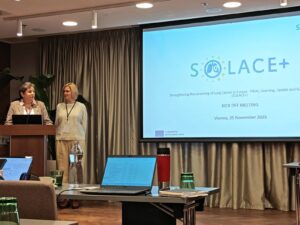
A dedicated session also focused on SOLACE+ data management, the data platform and ethical and legal aspects of the project.
Over the one day meeting, partners exchanged ideas, defined priorities and aligned their efforts to ensure SOLACE+ achieves its ambitious goals.
The SOLACE+ project is co-funded by the European Union’s EU4Health programme under Grant Agreement No. 101314323.