
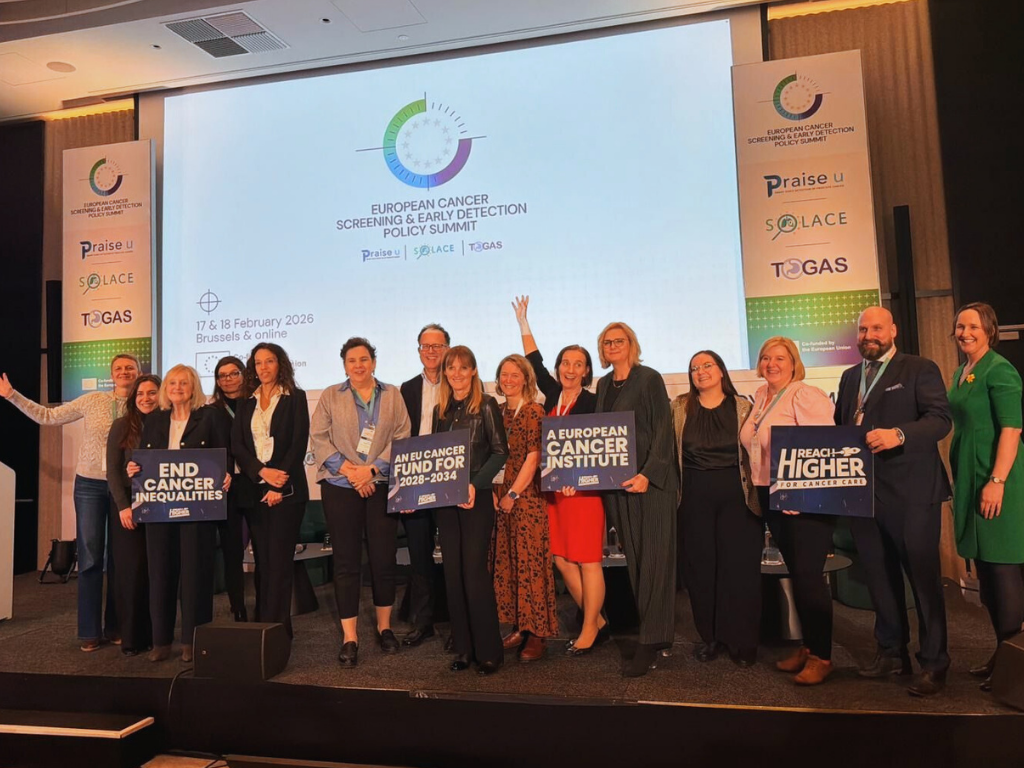
Key moments from the European Cancer Screening and Early Detection Policy Summit
The European Cancer Screening and Early Detection Policy Summit (17–18 February, Brussels) brought together policymakers, clinicians, patient advocates and researchers to discuss the findings from three EU4Health-funded projects: SOLACE (lung cancer), PRAISE-U (prostate cancer) and TOGAS (gastric cancer).
SOLACE — Strengthening the Screening of Lung Cancer in Europe — is a three-year project focused on making lung cancer screening more accessible across Europe, particularly for high-risk groups currently underrepresented in screening such as women, people from marginalised communities, and those living with a lung condition.
What happened
The summit was an opportunity for the SOLACE team to present what three years of work across 11 pilot countries have delivered, and to outline the steps still needed to make lung cancer screening a reality across Europe.
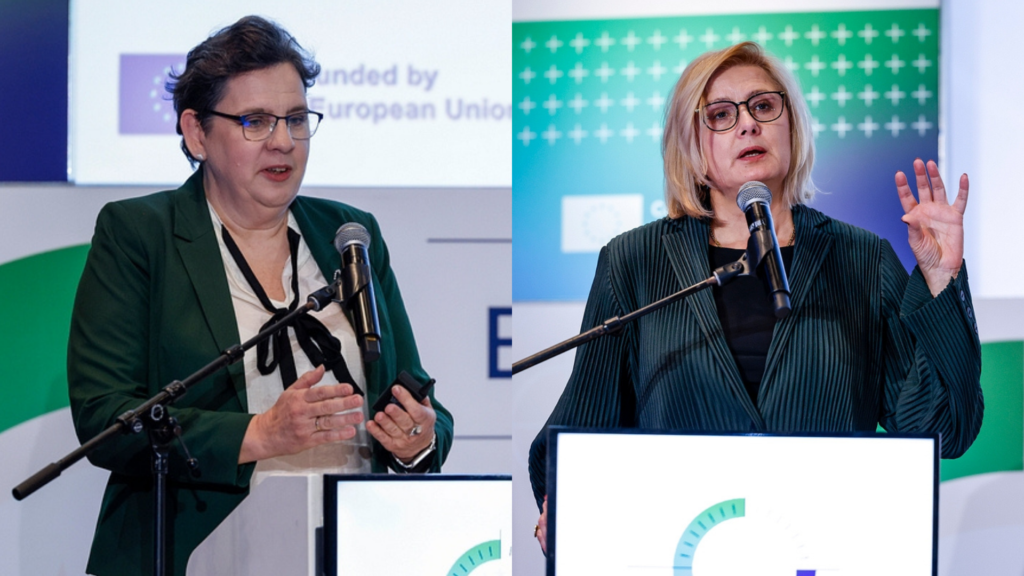
SOLACE Co-Scientific Coordinators Dr Anna Kerpel-Fronius and Prof Joanna Chorostowska-Wynimko presented the project’s results. SOLACE has screened over 30,000 people across Europe — well above the project’s original target — including over 9,000 women, 5,000 people from underserved communities, and 3,000 individuals with a lung condition.
Anna said: “We know that lung cancer screening works, but we wanted to know the best ways it can work in Europe.” That meant adapting to local realities; in some countries, people were invited to hospitals, while in others, the project brought screening directly to communities using mobile CT units. “We did both. It is astonishing how many countries have joined this project,” she said.
Joanna also highlighted that reaching and engaging the right people was one of the project’s key learnings: “The recruitment process proved to be one of the biggest challenges. But we have shown that we need tailored interventions, and we have to understand the cultural context of every targeted population. Implementing quality control at all stages of lung cancer screening is a must.”
Learning from lung screening participants
A central theme of the summit was the importance of listening to the people that lung cancer screening is designed for.
Pippa Powell, Director of the European Lung Foundation, said: “This project was not about doing as many lung cancer screenings as possible. It was about how to provide it to the people that need it the most.”
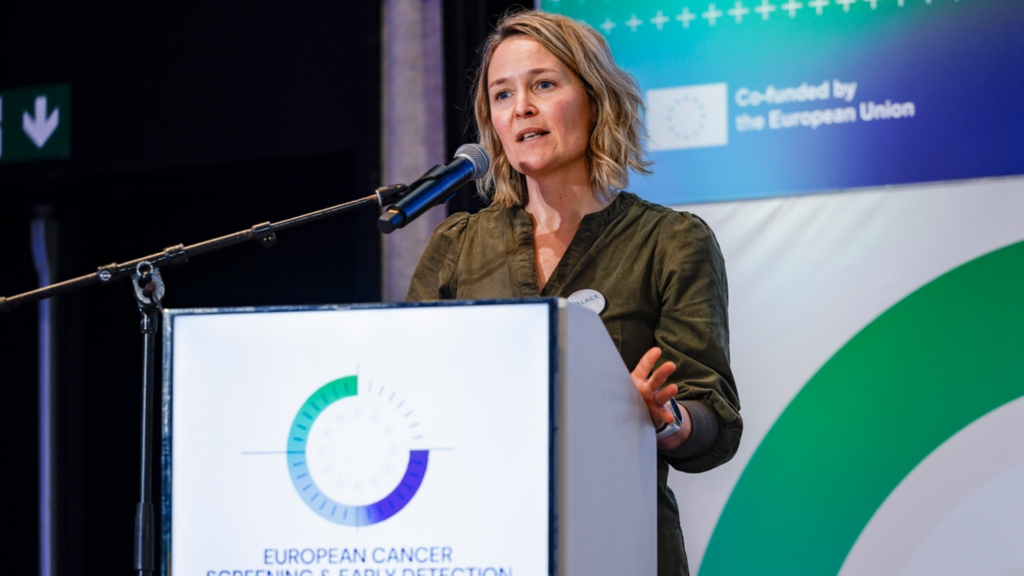
SOLACE engaged communities across multiple countries, demographics and socioeconomic statuses to gather stories and experiences directly from participants. The team highlighted that this should happen at every stage, as Pippa says: “before the screenings to find out what they need, during the programme to see what is working for them, and then afterwards, to learn about their experience.”
Watch the stories from France, Greece, Poland and Ireland to hear what lung screening participants said about their experiences.
What’s next
As SOLACE approaches its conclusion in March 2026, several initiatives are in place to carry the work forward.
The SOLACE Knowledge Hub (hub.solacelung.eu) will continue to provide freely accessible guidelines, tools, and resources for anyone implementing a lung cancer screening programme, as well as for people who want to know whether lung cancer screening is right for them.
The European Lung Cancer Screening Alliance (ELCSA), established by the European Respiratory Society and the European Society of Radiology and announced during the summit by Joanna (ERS President) and Helmut Prosch (ESR), will sustain the networks built through the project.
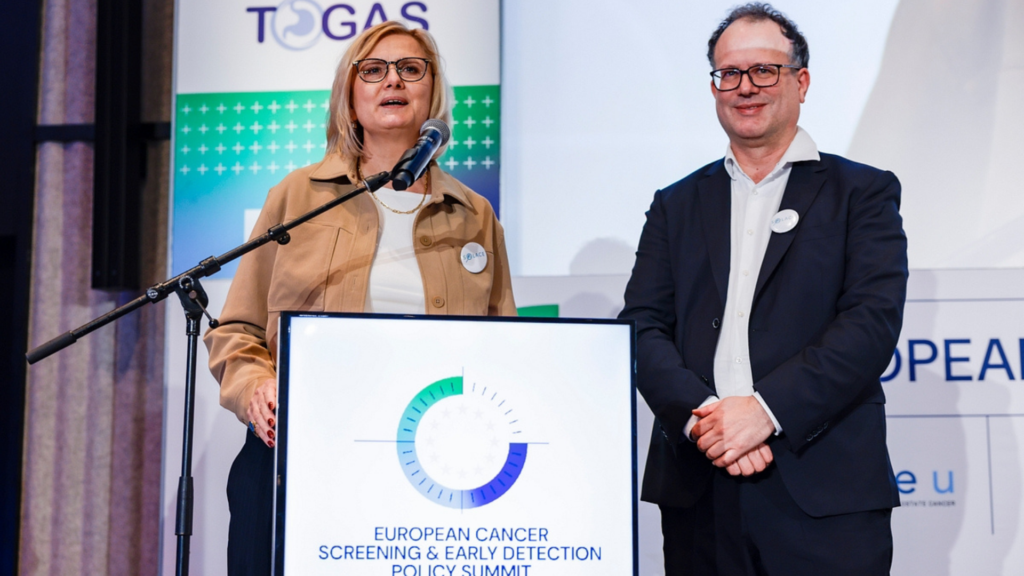
Looking further ahead, the consortium is working towards SOLACE+, a proposed next phase that, if funded, will support more countries in moving from pilots to national programmes and extend the project’s impact across Europe.
A recurring message during the summit was the need to shift how lung cancer screening is perceived — away from something associated with fear or stigma, and towards a positive, routine part of healthcare. SOLACE has shown that screening is effective for earlier detection of lung cancer and that it can effectively reach underserved but high-risk populations. The challenge now is making that the norm.
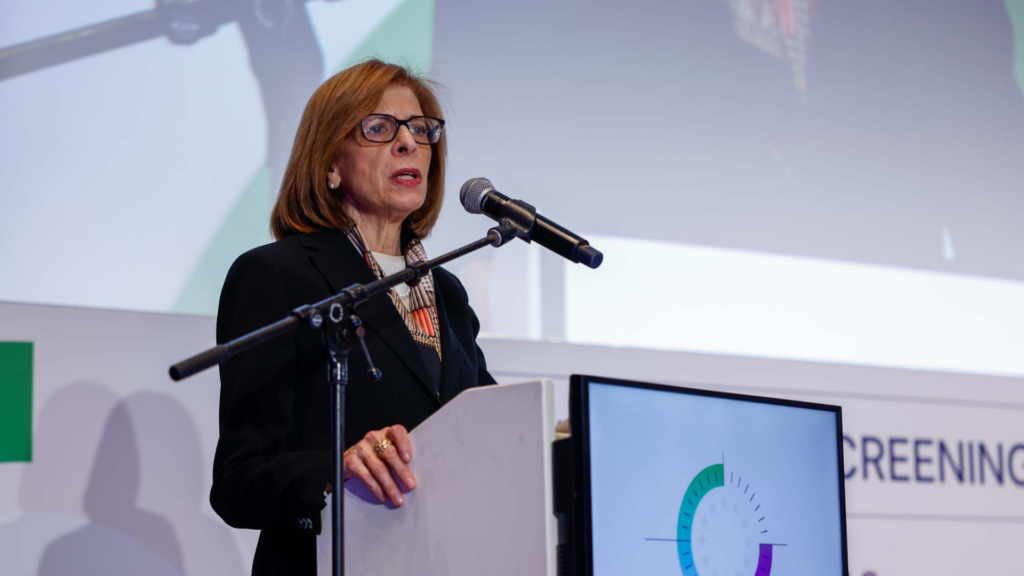
As Stella Kyriakides, former EU Commissioner and summit co-chair, said: “Equity is not optional. New screening programmes shouldn’t widen existing inequalities between Member States, between regions or socioeconomic groups. Every year of delay means more late diagnosis, more aggressive treatments and more loss of life.”
More information
For health professionals:
For the public and screening participants:
- What is screening?
- Who is screening for?
- The lung cancer screening process
- The truth about lung cancer screening myths
Photos via the European Cancer Organisation