


Pulmonary rehabilitation in adults
Pulmonary rehabilitation is a programme that supports people living with a long-term lung condition to improve breathing, build strength and stay active and independent. It aims to deliver the skills they need to better manage their condition at home.
Understanding pulmonary rehabilitation
Who is pulmonary rehabilitation for?
Pulmonary rehabilitation can help you if you have a long-term lung condition and if you experience daily breathlessness that affects your life activities.
If you have one of the following conditions, you may benefit from pulmonary rehabilitation:
- Interstitial lung disease, e.g. idiopathic pulmonary fibrosis
- Before or after a lung operation, or lung transplant
You may be offered pulmonary rehabilitation to work alongside other treatments, such as medications, oxygen and breathing support machines (such as masks used at night).
What are the benefits?
“Pulmonary rehabilitation will not cure our disease but it can give us back a part of our life. It gives us a sense of control in diseases where so much feels uncontrollable.” (Eleni, who lives with a lung condition)
Pulmonary rehabilitation is designed to help you do more of the things you enjoy and feel better day-to-day.
You may find that pulmonary rehabilitation helps you feel more confident and in control of your life. It can make real positive differences to your day-to-day living. Pulmonary rehabilitation also aims to improve your overall health, which can help to reduce the number of chest infections you get and lower your need for hospital visits.
Evidence from research studies has shown that pulmonary rehabilitation can produce the following changes (note that not everyone will experience all of these changes):
- Better quality of life
- Improved mental health
- Ability to return to work
- Ability to do more daily activities (e.g. walking to the shops, cleaning the house)
- Less breathlessness and tiredness
- Reduced likelihood of needing to see a healthcare professional or having to stay in hospital
- Ability to do more physical activity and exercise
- Greater understanding of your condition and how to manage it
- Improved physical strength
- Increased connections with other people
“Thanks to a multidisciplinary team that worked truly together, I learned how to manage my daily energy and master proper breathing techniques. Their coordinated care gave me my life back: I went from suffering from a lung disease to truly living with it.” (Martijn, who lives with a lung condition)
Accessing pulmonary rehabilitation
Pulmonary rehabilitation can be delivered in different ways. It can take place at hospital, at home, online, or in community settings. It is tailored to suit your needs and lifestyle and is often delivered in groups.
How do I get referred?
If you have a diagnosed lung condition that affects your breathing, you can be referred for pulmonary rehabilitation by your doctor or another healthcare professional involved in your care.
Before starting a pulmonary rehabilitation programme, a healthcare professional or team of professionals will check your health to make sure the programme is safe and right for you. This may include asking some questions and doing a few simple tests to understand how your lungs and body are working. This typically includes:
- Checking how severe symptoms are
- Asking questions about day-to-day living
- Simple breathing tests (spirometry)
- Assessing overall fitness and health
- If you smoke, you may also be offered support to help you stop, as this can greatly improve your lung health.
Pulmonary rehabilitation programmes follow the same safety and quality standards across Europe, but the way you access them differs between countries. Differences could include:
- Referral routes: in some countries, only doctors can make referrals. In others, different healthcare professionals may also refer you.
- Screening requirements: some countries have different screening processes and may require additional tests before starting.
- Programme structure: the length of the programme and the facilities and equipment available may vary, but the main goals and monitoring of progress should follow standard guidelines (see link to the ERS guidelines on pulmonary rehabilitation).
If pulmonary rehabilitation may help you, it is worth asking your healthcare professional whether it is available locally or if there are plans to introduce a programme in the area.
Why might someone not be referred?
Pulmonary rehabilitation might not be suitable if you are waiting for other test results to learn more about your symptoms. It is also best to make sure you are taking the right medicine to manage your condition before you are referred, although this is not a reason on its own to not refer you. Pulmonary rehabilitation is usually offered at the stage when breathlessness affects your daily life.
It may be unsuitable for you, or you may need to postpone starting the programme until certain health conditions are well controlled through medication or other treatments, such as:
- Heart conditions, including chest pain (angina), heart failure, or a recent heart attack.
- Physical limitations, such as severe joint or bone problems that make it impossible to exercise safely.
- Severe memory or thinking problems that would prevent you from being able to follow the programme.
- Severe lack of oxygen in your blood stream without taking oxygen supplementation.
A healthcare professional will check your medical history and decide if you are eligible for the programme.
Support to help you attend
Attending the programme might be difficult at the beginning because of your breathing difficulties, but over time it is expected you will get stronger and it will become much easier to attend the sessions.
If other reasons, such as work or distance, affect your ability to attend, please ask you healthcare professional for other options. These might include online or home-based rehabilitation if it is available in your local area.
The programme
Tailoring the programme
Each programme starts with a healthcare professional checking your personal health and fitness levels. All exercises and recommendations should be uniquely tailored to you as an individual, considering your specific disease severity, any other conditions and your personal goals.
What does a typical programme include?
A typical programme usually lasts between 6 and 12 weeks, with at least 2 sessions per week. It is likely to include exercise, breathing techniques, education and nutritional support. It may also include psychological support as your mental wellbeing is an important part of your care.
Pulmonary rehabilitation programmes may take place in groups at a hospital, specialised rehabilitation centres, local doctor setting or health centres, or in a community location, such as a community hall or a leisure centre. In some cases, you may be offered a one-to-one programme at your home or a stay at a specialised rehabilitation centre.
After an initial assessment, the healthcare professional supervising your programme will work with you on a plan that is safe and appropriate for your fitness level. Your progress should be regularly monitored to track your improvement. You may also be offered supplemental oxygen to help you during the programme.
What types of exercises might be included?
The exercise training programme involves various activities to help make daily life easier:
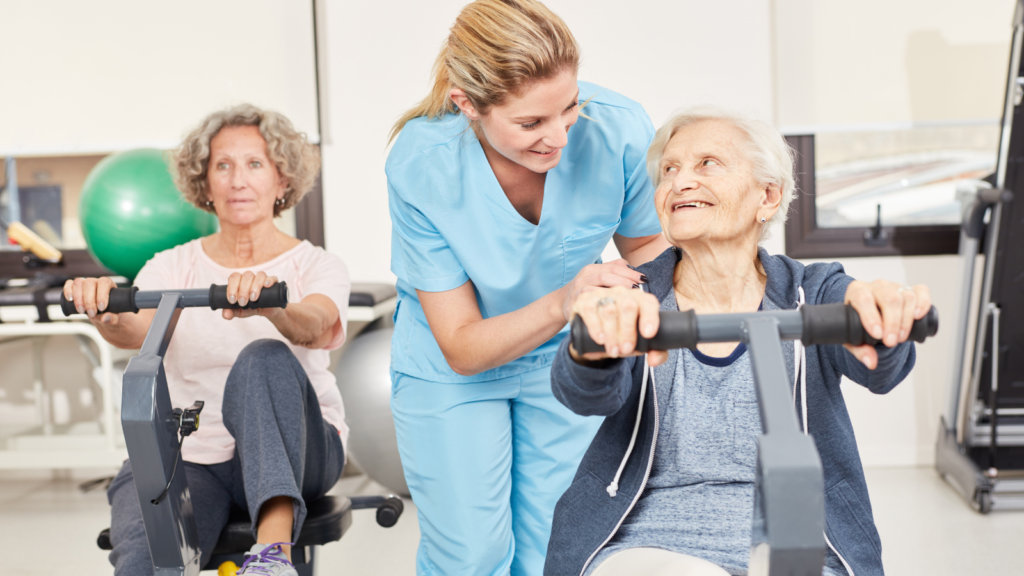
- Continuous endurance exercises: activities like walking or cycling continuously to help the body stay active for longer.
- Stop and start (also called intermittent or interval) endurance exercises: short bursts of moderate-to-higher effort exercise followed by breaks or more gentle movement, allowing you to exercise for longer with less discomfort.
- Strength exercises: movements such as lifting small weights. This includes upper and lower body exercises (e.g., sit-to-stand, resistance bands), gradually building up the weight and number of repetitions to safely build muscle strength.
- Day-to-day movements: specific exercises that mimic movements needed for everyday activities, such as balancing, stepping, reaching and bending.
- Breathing exercises: designed specifically to strengthen the muscles used for breathing. These include ways of breathing more deeply and with different mouth positions, with clear instructions on when and how to use these in daily life.
- Breathing control and pacing exercises: this includes pursed lip breathing to help manage breathlessness.
Your healthcare team will make sure you exercise at a level that is right for you. You may feel breathless during these exercises, but this is normal and safe. You should however stop the exercise and seek advice if you have chest pain, dizziness or severe or unusual breathlessness.
“Before my lung condition, I had been a member of triathlon, cycling and swimming clubs and a gym. When I first turned up at a pulmonary rehabilitation class, my initial reaction was to think ‘what has my life become?’. I was used to pushing myself to the limits and I wanted to leave before it even started because I felt embarrassed doing some of the exercises.
My wife encouraged me to complete the programme and I quickly realised that it taught me how to exercise within my new limits and, more importantly, how to avoid causing myself harm whilst exercising. This lifted my spirits as I realised it would help me maintain a level of fitness.” (Ron, who lives with a lung condition)
What do the educational sessions involve?
Sessions are structured in a step-by-step way to build knowledge over time. Usually there is one educational topic per session. Topics include:
- education about your condition
- breathlessness management
- managing anxiety and mood disorder
- tiredness management
- what to do if your symptoms suddenly get worse
- diet/nutrition.
Some services may also cover other important topics such as advanced care planning or end-of-life planning.
There is a lot of advice available through the educational sessions and plenty of opportunity for one-to-one discussions. Sessions are interactive, with opportunities to ask questions, share experiences, and receive personalised advice.
There will be support for goal setting and continuing exercise after the programme. You may also be referred to other services, such as smoking cessation or one-to-one psychological support.
Digital tools and technology/home-based training
Some programmes will use digital tools, such as apps or online platforms, to check your progress in the programme and also to deliver sessions remotely, based on individual needs identified during the programme.
These tools can also be used as a way to check in with healthcare teams. Find out more about remote monitoring and digital tools.
Staying active after your programme
At the end of the programme, a follow-up assessment takes place to check your progress. Advice and support are offered at this stage to help your continue the benefits of the programme after it finishes.
The benefits of the pulmonary rehabilitation programme can last for many months, especially if you continue to stay active after the programme. Choose exercises that you enjoy, and that match your physical abilities and lifestyle. This will make it more likely that you will carry on doing them. You could involve family members and caregivers to help support build these long-term habits so that they last.
Try to regularly include physical activities, such as walking and gardening, in your daily routine, so that you are naturally doing things that benefit your health. You might like to join an exercise group or class in your area to also keep up the social aspects of the programme.
If you find that your health gets worse again, you should get medical advice early rather than waiting for symptoms to worsen more. Your healthcare professional may be able to refer you for another course of pulmonary rehabilitation to help you regain some of the progress you previously made.
Useful resources
This material was compiled with the help of Dr Enya Daynes, Dr Ioannis Vogiatzis, Dr. Orania Koltsida (MD, PhD, MSc (pulmonologist)), Maria Koulopoulou (MSc, SRPT) and members of ELF Patient Advisory Groups.
This page was last updated 2026.
