Our core content on Lung conditions and related factsheets has been translated to a number of other languages.
For more languages explore all available Factsheet translations.
Volunteer as a translator or learn how to translate using Chrome, Firefox or Edge browsers.
 European Lung Foundation

Our core content on Lung conditions and related factsheets has been translated to a number of other languages by our volunteer team.
For more languages explore all available Factsheet translations.
Volunteer as a translator or learn how to translate using Chrome, Firefox or Edge browsers.
Home » Promoting respiratory health among underserved communities in Guatemala
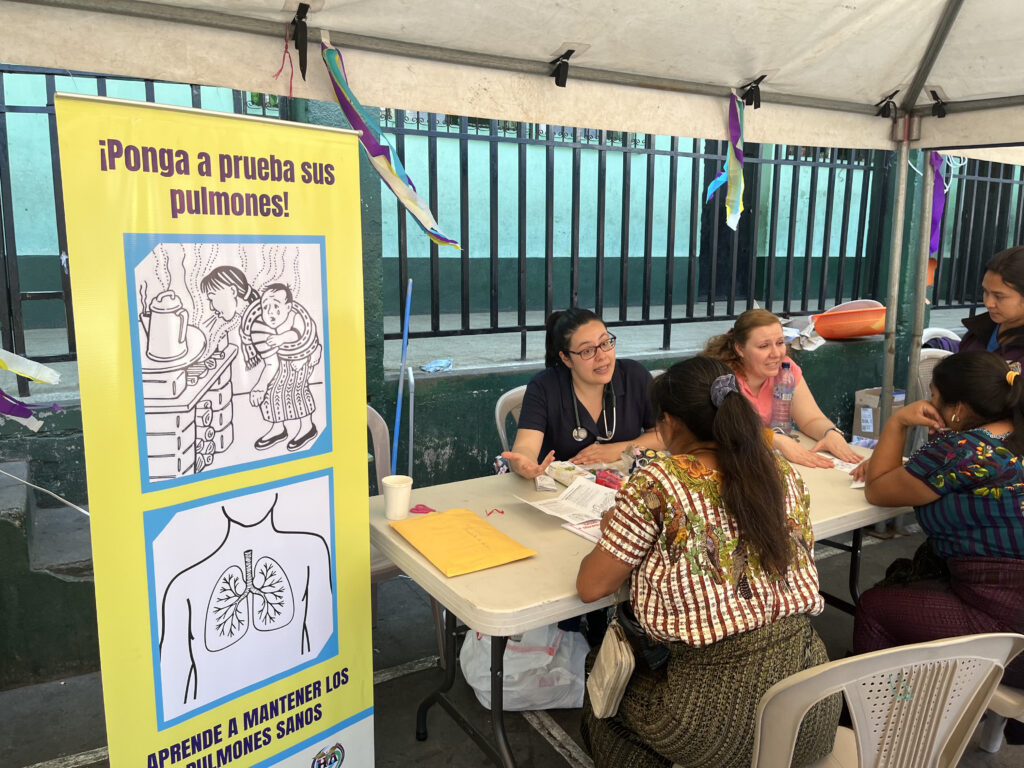
In the mostly Indigenous Tz’utujil Maya community of Santiago Atitlán, Hospitalito Atitlán ran an outreach event with lung‑health education, a simple balloon lung‑test and peak‑flow monitoring. Around 200 people attended; 16 were given peak‑flow meters and urged to seek follow‑up care. Broadcasts on radio and TV amplified the message to the wider community.
In the Santiago Atitlán region, the majority of the population—over 90 per cent—identifies as Indigenous Tz’utujil Maya. Respiratory health is an urgent yet often overlooked public health concern. Many women over the age of 40 do not speak Spanish, limiting access to essential health information, particularly regarding the long-term dangers of air pollution.
Most residents rely on traditional cooking methods, such as open three-stone fires or wood-burning stoves, which release harmful smoke into living spaces. In many households, cooking takes place indoors or in rooms where families also sleep, resulting in prolonged exposure to smoke and other pollutants. Wider community practices also contribute to poor air quality, and in 2021, lower respiratory infections were the third leading cause of death in Guatemala, following diabetes and ischemic heart disease.
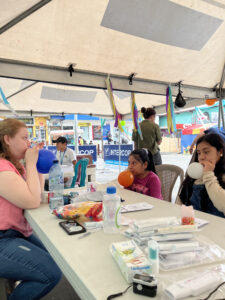
Hospitalito Atitlán organised a Healthy Lungs for Life event to address this health disparity while reinforcing the campaign’s global message. A simple balloon test was used to assess lung function and engage participants in discussions about lung health.
Around 200 people attended the event, with 16 individuals receiving a peak-flow meter to monitor their own lung health. Those showing signs of concerning lung function were encouraged to seek further medical follow-up. The event was also broadcast on several radio stations and television channels, reaching an even wider audience.
Sign up to get the latest information and research on lung conditions, hear about our upcoming events and campaigns, plus views from experts and patients! You can unsubscribe at any time.
ELF is a non-profit organisation registered as a UK company (VAT no. GB 115 0027 74) and charity (no. 1118930).
Our Brussels office enterprise number is 0738.383.695
European Lung Foundation's TR ID number in the Transparency Register is: 094039644810-79
| Cookie | Duration | Description |
|---|---|---|
| __Secure-ROLLOUT_TOKEN | 6 months | Description is currently not available. |
| __Secure-YEC | past | Description is currently not available. |
| __Secure-YNID | 6 months | Description is currently not available. |
| Cookie | Duration | Description |
|---|---|---|
| _clck | 1 year | Microsoft Clarity sets this cookie to retain the browser's Clarity User ID and settings exclusive to that website. This guarantees that actions taken during subsequent visits to the same website will be linked to the same user ID. |
| _clsk | 1 day | Microsoft Clarity sets this cookie to store and consolidate a user's pageviews into a single session recording. |
| _ga | 1 year 1 month 4 days | Google Analytics sets this cookie to calculate visitor, session and campaign data and track site usage for the site's analytics report. The cookie stores information anonymously and assigns a randomly generated number to recognise unique visitors. |
| _ga_* | 1 year 1 month 4 days | Google Analytics sets this cookie to store and count page views. |
| CLID | 1 year | Microsoft Clarity set this cookie to store information about how visitors interact with the website. The cookie helps to provide an analysis report. The data collection includes the number of visitors, where they visit the website, and the pages visited. |
| MR | 7 days | This cookie, set by Bing, is used to collect user information for analytics purposes. |
| SM | session | Microsoft Clarity cookie set this cookie for synchronizing the MUID across Microsoft domains. |
| Cookie | Duration | Description |
|---|---|---|
| yt-remote-cast-available | session | The yt-remote-cast-available cookie is used to store the user's preferences regarding whether casting is available on their YouTube video player. |
| yt-remote-cast-installed | session | The yt-remote-cast-installed cookie is used to store the user's video player preferences using embedded YouTube video. |
| yt-remote-connected-devices | never | YouTube sets this cookie to store the user's video preferences using embedded YouTube videos. |
| yt-remote-device-id | never | YouTube sets this cookie to store the user's video preferences using embedded YouTube videos. |
| yt-remote-fast-check-period | session | The yt-remote-fast-check-period cookie is used by YouTube to store the user's video player preferences for embedded YouTube videos. |
| yt-remote-session-app | session | The yt-remote-session-app cookie is used by YouTube to store user preferences and information about the interface of the embedded YouTube video player. |
| yt-remote-session-name | session | The yt-remote-session-name cookie is used by YouTube to store the user's video player preferences using embedded YouTube video. |
| ytidb::LAST_RESULT_ENTRY_KEY | never | The cookie ytidb::LAST_RESULT_ENTRY_KEY is used by YouTube to store the last search result entry that was clicked by the user. This information is used to improve the user experience by providing more relevant search results in the future. |