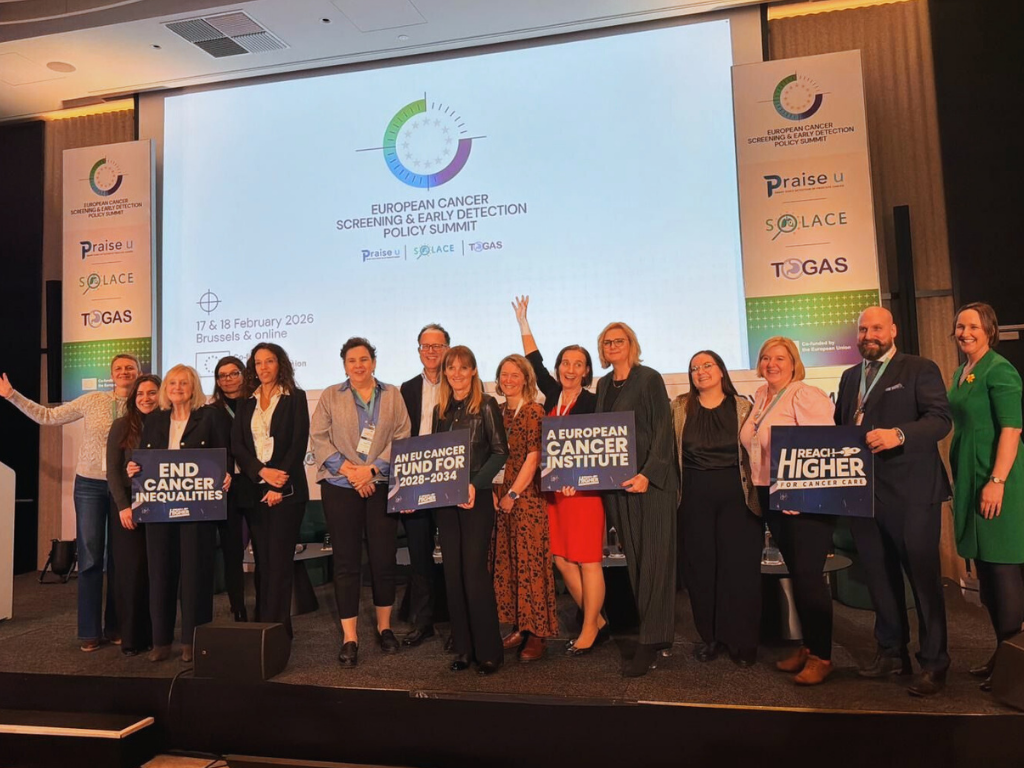
On 17 to 18 February 2026, ELF attended the European Cancer Screening and Early Detection Policy Summit in Brussels, organised by the European Cancer Organisation.
The Summit brought together patient organisations, advocates, healthcare professionals and policymakers to review progress in cancer screening across Europe and how cancer screening can be made more accessible, supportive and patient-centred. A key theme was translating European recommendations into national screening programmes for lung, prostate and gastric cancer. Speakers emphasised the importance of implementation, equity and building patient trust.
The EU-funded SOLACE project was prominently featured throughout the programme, alongside fellow pilot initiatives PRAISE U and TOGAS. Results from pilot sites demonstrated that national lung cancer screening programmes are feasible across diverse European health systems.
ELF highlighted its role in SOLACE, which is which aims to develop, test and disseminate tools to support the implementation of structured lung cancer screening programmes across Europe under the EU4Health Programme. Through the ELF Lung Cancer Patient Advisory Group and collaboration with Lung Cancer Europe, patients and patient organisations have helped shape the project since its launch in April 2023.
On day one, ELF Director, Pippa Powell, presented findings from SOLACE pilot sites in Poland, Czech Republic, Greece and Ireland. She explained:
“SOLACE was not about doing as many lung cancer screenings as possible. It was about how to provide it to people that need it the most.”
“We had the privilege to go to different countries and interview these amazing people and ask them questions about their lung cancer screening experience. SOLACE took mobile screenings to them and we found innovative ways to reach out to people who need this the most.”
“We need to talk to people before the screenings to find out what they need, during the programme to see what is working for them and then afterwards, to learn about their experience.”
Feedback from participants showed that when screening is delivered in a supportive and non-judgmental way, particularly for people who smoke or have smoked, it is experienced as straightforward and positive.
Fear of screening and possible results can prevent people from attending. Speakers emphasised supportive, non-judgmental approaches, especially for smokers or people with a history of smoking.
Maria, a participant in lung cancer screening whose story was shared by Pippa, highlights that prevention can be empowering. Screening is not just about illness; it can be an act of self-care and loving your life. Her experience shows that with the right support, screening can be a positive, confidence-building step.
SOLACE pilots used mobile units, community mediators and outreach to reach groups that are often underrepresented, including women and people who are hard to reach. In some pilots, most participants came from the high-risk groups the programme aimed to support.
Speakers highlighted several key messages:
The event also highlighted how European recommendations can be translated into national screening programmes. Speakers, including Debra Montague, President of Lung Cancer Europe, called for lung cancer screening to be a priority in national cancer plans. She said:
“We must translate recommendations to actionable strategies. We urge all Member States to continue ambitious implementation by drafting national plans with actionable targets.”
“We must make lung cancer screening a priority in national cancer plans by allocating the necessary resources, as well as engaging primary care providers, and by utilising data tracking effectively.”
Speakers stressed the importance of reducing stigma, addressing inequalities and using lessons from SOLACE, PRAISE U and TOGAS to strengthen national programmes.
The launch of the European Lung Cancer Screening Alliance (ELCSA) by the European Respiratory Society (ERS) and European Society of Radiology (ESR) at the event marks ongoing collaboration to make lung cancer screening more patient-centred and accessible.
ELF is proud to have contributed to SOLACE by ensuring that patients and patient organisations were involved at every stage. Screening is possible, participation is possible, and with the right support, it can be a positive step in looking after your health.