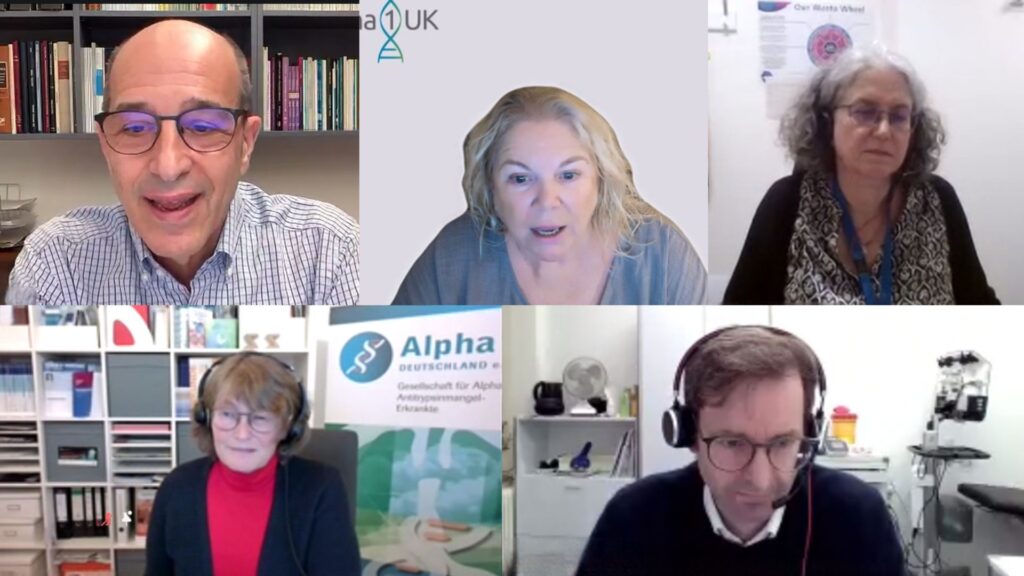
You can now watch the recording and read our summary of the recent alpha-1 antitrypsin deficiency (AATD, or alpha-1) patient webinar.
Alpha-1 antitrypsin deficiency (AATD or alpha-1) is a genetic condition which increases the risk of lung and/or liver diseases. On 4 November 2026, a free webinar brought together over 200 people living with the condition – alongside patient organisations, researchers and healthcare professionals – to explore the latest developments in research, treatment and care.
Members of the European Lung Foundation’s new patient group for alpha-1 also took part in the event.
Moderated by Karen O‘Hara (Alpha-1 UK Chair and Alpha-1 European Alliance board member) and Dr Beatriz Lara (European Alpha-1 Research Collaboration (EARCO) Early Career Member and Patient Advocacy Lead), webinar topics included updates from the European Respiratory Society (ERS)’s first alpha-1 conference held on 23–24 October 2026 and the work of EARCO. Speakers also answered questions from attendees during a live Q&A session.
The webinar explored promising developments in new treatments for alpha-1, advances in chronic obstructive pulmonary disease (COPD) care and the important role people living with alpha-1 play in shaping future research.
Pulmonologist and researcher Professor Christian Clarenbach began by introducing the work of EARCO. This network promotes the exchange of ideas among clinicians, scientists and patients, undertakes clinical research and ensures patient involvement in it. Patients have been part of the network from the beginning and have helped identify its research priorities.
EARCO’s registry now includes information from more than 5,000 people living with alpha-1 across 129 centres. By following people over time, researchers can better understand how the condition develops and assess the impact of current and future treatments.
Research has been completed or is ongoing into:
ERS President, pulmonologist and researcher Dr Marc Miravitlles outlined key research findings presented at the recent ERS Alpha-1 Antitrypsin (AATD) Conference and at the 2026 ERS Congress.
Dr Miravitlles noted that, apart from treatment that delivers infusions of alpha‑1 antitrypsin (augmentation therapy), treatment options have not changed much over the past 40 years. He highlighted several exciting developments, including therapies that aim to fix the faulty gene responsible for alpha-1 deficiency. Researchers are still looking at whether these treatments are safe over the long term.
Looking ahead, he said researchers are exploring a range of new approaches, including improved replacement therapies, oral medicines and gene-based treatments. Several potential therapies are already being tested in clinical trials, marking one of the most promising periods for alpha‑1 research in decades and offering hope for people living with the condition and their families.
Marion Wilkens, a patient advocate and president of the German patient organisation Alpha1 Deutschland e.V., then discussed the importance of patient support, education and involvement in research and outlined several ways patients can get involved. Marion emphasised that patient experiences are vital for improving research and future care.
The webinar was developed with contributions from the European Alpha-1 Research Collaboration (EARCO), the Alpha-1 Europe Alliance, Alpha-1 UK, Alpha1 Deutschland e.V. and the European Lung Foundation.