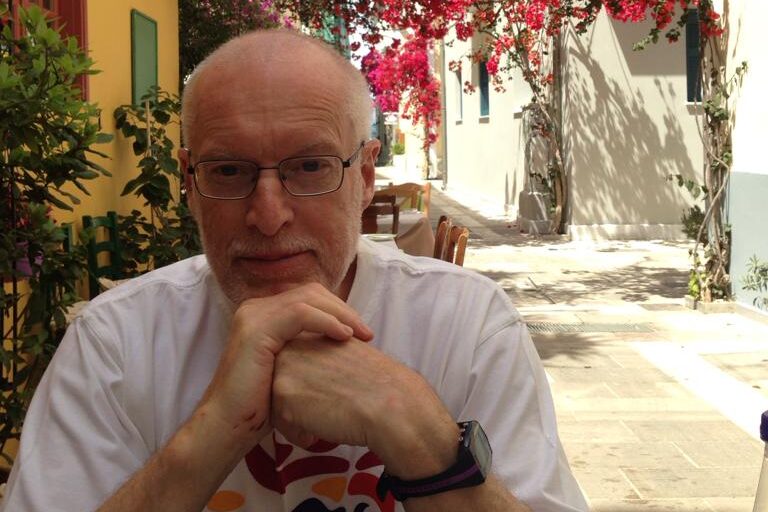
This month, we spoke with Phil Taverner, the incoming ELF Chair for the 2026–2029 term, whose mandate begins in September. Here, we get to know him a bit better and learn about his goals as he steps into this new role.
I live in Bedford, about 70km north of London in the UK. My wife and I moved there from the South Coast to be near our two granddaughters when I retired from my main career.
For most of my career, I worked as a social and community worker in both the UK and New Zealand, for local authorities and national charities. I then moved into public health research with the National Institute for Health Research for the last ten years of my working life. Since retiring, I have been involved in many advocacy roles in various settings.
I was diagnosed with asthma as a child and have lived with the condition for about 65 years. More recently, I was diagnosed with bronchiectasis during investigations after my first COVID-19 infection. I also had a heart attack in 2017, which means I now need to consider how different conditions, and the treatments for them, interact with one another.
I began volunteering for Asthma UK (now Asthma and Lung UK) around 20 years ago. My first involvement was running the London Marathon to raise funds, but this soon develope into patient advocacy work across a range of projects.
What has most inspired my involvement in patient advocacy is the combination of my 40 years’ experience as a community worker and 10 years working in health research. I am very aware that I am only here because of the work of scientists who have developed effective treatments, and the skill and dedication of medical professionals who have cared for me over many years. This background has also given me a strong understanding of how research and healthcare systems work in practice.
At the same time, advocacy is central to community work, so it feels natural to me that patients should be informed and active partners throughout the process. Scientists and clinicians are experts in their fields, but patients are the only experts in their own lives. The best outcomes come when all this expertise is brought together.
I first got involved with ELF when they and Asthma + Lung UK were applying for an EU grant. I was one of the patient representatives on the group coordinating the bid. I was previously a member of the Asthma Patient Advisory Group, have reviewed research applications and other papers and, more recently, have been a member of the Air Pollution and Climate Change Working Group. I have also co-chaired two online patient conferences on the topic. I was also involved in two patient workshops at ERS Congress in 2025.
Although I am formally retired, I am not ready to stop working. I have 50 years of experience, much of which involves working in environments that bring scientists, clinicians and patients together (for example, chairing NICE guideline committees in the UK). This role therefore felt like a good fit for me. I want to make that experience available to a cause that is important to me.
On a personal note, it allows me to be a European again. I took the UK’s decision to leave the EU as something of a personal affront. I worked with organisations across Europe during my social work career, campaigning on children’s rights. I am very excited to be working on a European stage again and sharing experiences with people across the continent.
I see the ELF Chair role as one leg of a relay race, in which the incoming chair takes the baton from the last person with all the energy and effort that they have poured into it to get it to that point. In this context, I hope to learn from how Dimitris has managed all the important relationships involved, both with scientists and clinicians and with the many patient organisations that are part of the network. I am sure to benefit from his insight into what he has found works to advance the patient perspective.
It will be great to have a few months to watch him in action and learn what I need to do for the next leg of the race.
My priorities will be informed by discussions with the Council, ELF members and others. In keeping with my community work background, I see myself as representing a collective view. Having said that, the issue that most concerns me is air pollution and climate change. This is already part of the ELF agenda, but I think it will become more prominent as time goes on.
Another major concern for me is the rise of conspiracy theories across the World and the resulting loss of confidence in science. I hope to use my position to help strengthen the bridges between the public and the scientific community, at least in the area of respiratory health.
A new challenge and the opportunity to work with diverse groups of people across Europe. One of my sources of inspiration from my youth to now has been Bob Dylan; one of his songs has the line: “he who’s not busy being born is busy dying”.
Just that I am genuinely excited at the prospect of meeting so many new people in such an important and stimulating area.