Patient representatives from across the ELF community are helping to lead discussions ahead of ERS Congress 2026, sharing their experiences of working alongside healthcare professionals and researchers to help improve lung health.
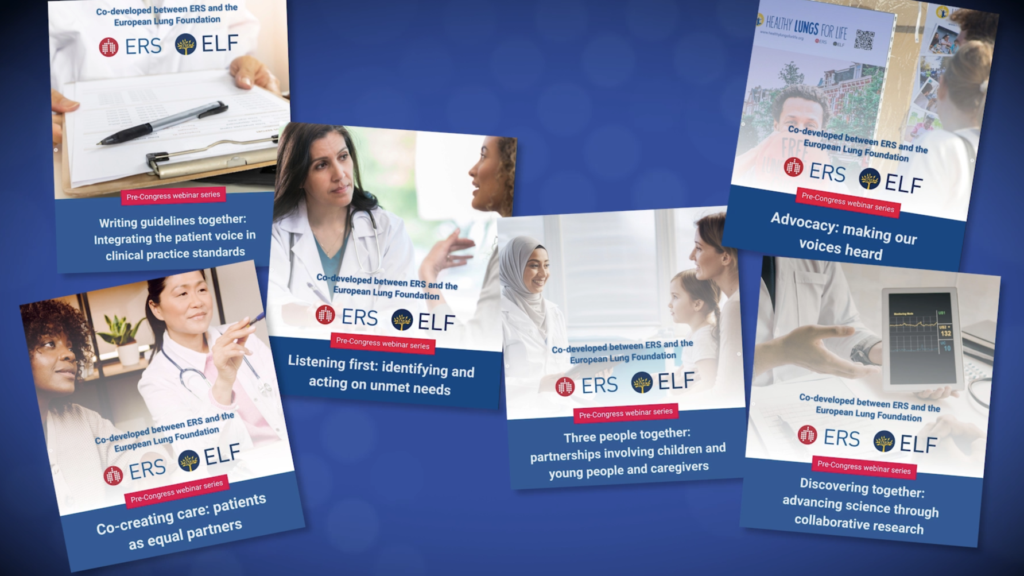
As part of the ERS Congress 2026 theme, “United for better breathing: partnership between patients, clinicians and researchers”, the European Lung Foundation (ELF) and the European Respiratory Society (ERS) have co-developed a series of webinars exploring how working together can improve care, shape research and raise awareness of lung health.
Each webinar is co-chaired by a patient representative and a healthcare professional. More than 20 patient representatives, advocates and patient organisation leaders from across Europe are contributing to the series.
Patient representatives from ELF Patient Advisory Groups, the ELF Youth Group and the ELF Patient Organisation Network are playing a central role throughout the series as speakers, chairs or discussion leaders. By sharing their experiences of living with lung conditions and working alongside healthcare professionals and researchers, they are helping to ensure that care, research and policy better reflect the needs of patients and their families.
Content Table
The series began on 27 May with a webinar co-chaired by Ilaria Galetti, a member of the ELF Pulmonary Fibrosis Patient Advisory Group.
The discussion focused on how patients, healthcare professionals and researchers can work together to develop clinical practice guidelines and standards that better reflect the experiences and priorities of people living with lung conditions.
Patient representatives Lucy Dixon, Chief Executive of PCD Support UK, and Eliza Kompatsiari, a member of the ELF Bronchiectasis Patient Advisory Group, shared their experiences of contributing to ERS clinical practice guidelines, showing how patient experiences can help shape recommendations that guide diagnosis, treatment and care.
Courtney Coleman and Clare Williams from ELF discussed how practical support, training and coordination can enable patients to participate meaningfully in guideline development alongside healthcare professionals.
The second webinar took place on 1 June and explored how patients, healthcare professionals and researchers can work together to shape services that better meet the needs of the people using them.
Co-chaired by Liam Galvin, Chair of ELF’s Patient Advisory Committee and co-founder of the European Pulmonary Fibrosis Federation, the session focused on co-designing respiratory care, improving access to services and ensuring patient perspectives inform how healthcare services are delivered.
Pieter van Eck, a member of the ELF COPD Patient Advisory Group, shared his experience of co-designing integrated care following his COPD diagnosis, while Noelle Morgan, who lives with asthma, spoke about the importance of involving patients in decisions about how healthcare services are designed and delivered.
Held on 30 July, the third webinar explored how children and young people can work alongside their caregivers and healthcare professionals to have a say in the care they receive and the research that affects them.
Co-chaired by Ed Powell, a young person living with bronchiectasis and Chair of the ELF Youth Group, the session focused on involving children and young people in healthcare decisions, research and service development. Panagiota-Maria Triantafyllopoulou, a young person living with severe asthma and member of the ELF Youth Group, shared her perspective on being involved in decisions about her own healthcare, while paediatric respiratory specialist David Drummond discussed practical approaches to consulting with children and young people about their own care.
The webinar also highlighted the importance of involving families in research and care development. Christina Tischer from the Global Foundation for the Care of Newborn Infants and Sylvia Obermann from Care4Neo shared lessons from the BronQ Family Study, which was co-created with families based on their experiences. Parent representative Zena Powell also spoke about why she advocates for greater involvement of children and families in bronchiectasis care and research.
21 August 2026 | 14:00–15:00 CEST
Taking place on 21 August, the fourth webinar will explore how advocacy can drive change, from raising awareness of lung health and improving air quality to influencing national and international health policy.
The session will be co-chaired by Helen Parks, current Chair of the ELF United Patient Advisory Group (UPAG), incoming ELF Vice Chair and patient co-chair of the EXPLAIN-IT ERS Clinical Research Collaboration.
Speakers include Pippa Powell, Director of the European Lung Foundation, who will reflect on the development of the Healthy Lungs for Life campaign and its growth from a public awareness campaign into a programme that helps raise awareness lung health and influence policy, with examples of activities across the globe.
Anna Dworakowska, Executive Director and co-founder of Polish Smog Alert, will share lessons from advocacy campaigns that have helped drive action on air quality across Poland.
The webinar will also examine how advocacy can influence policy at European and global levels, including implementation of the World Health Assembly Lung Health Resolution.
31 August 2026 | 17:00–18:00 CEST
Taking place on 31 August, this webinar will explore how patients and healthcare professionals can work together to improve care through supported self-management, healthy lifestyle interventions and digital healthcare.
The session will be co-chaired by Louise Bouman, incoming Chair of the ELF UPAG and President of the Dutch Pulmonary Hypertension Foundation. A long-standing patient advocate living with pulmonary hypertension, Louise works with researchers, healthcare professionals and decision-makers across Europe to help ensure the patient perspective is heard. She will discuss why recognising patients as equal partners can help create more person-centred and effective healthcare.
Patient representatives Tanja Hedberg from Sweden and Richard Müller, a member of the ELF Asthma and COPD Patient Advisory Groups, will share their experiences of working alongside healthcare professionals. Living with a rare condition, primary ciliary dyskinesia (PCD), Tanja has contributed to patient advocacy initiatives, clinical practice guidelines and the BEAT-PCD Clinical Research Collaboration, helping to make sure research and care better reflect the needs of people living with PCD. Richard will explore the role of shared decision-making in supporting more person-centred care and stronger partnerships between patients and healthcare professionals.
1 September 2026 | 17:00–18:00 CEST
The final webinar in the series will explore how patients, clinicians and researchers can work together throughout the research process, from setting priorities and designing studies to sharing results and improving care.
The session will be co-chaired by Hilary Hodge, patient co-chair of the SHARP Clinical Research Collaboration and a member of the ELF Asthma Patient Advisory Group.
Dominique Hamerlijnck, a long-standing patient advocate, will discuss the role of patients in setting research priorities and shaping study design. Over the past two decades, she has worked alongside researchers on clinical trials and other research projects, helping to ensure research focuses on the issues that matter most to people living with lung conditions.
Helen Parks will share perspectives on involving patients throughout different stages of scientific research, while Lucie Widmann, a member of the ELF Chronic Cough Patient Advisory Group, will join Dr Marta Dąbrowska to discuss patient involvement throughout the NEUROCOUGH Clinical Research Collaboration.
Throughout the series, patient representatives are showing how sharing their experiences and working in partnership with healthcare professionals and researchers can lead to better care, more relevant research and stronger advocacy for lung health.
Join the remaining webinars, or catch up on previous sessions, to hear directly from the patients, advocates and healthcare professionals working together to improve care, shape research and strengthen the voice of people living with lung conditions.